
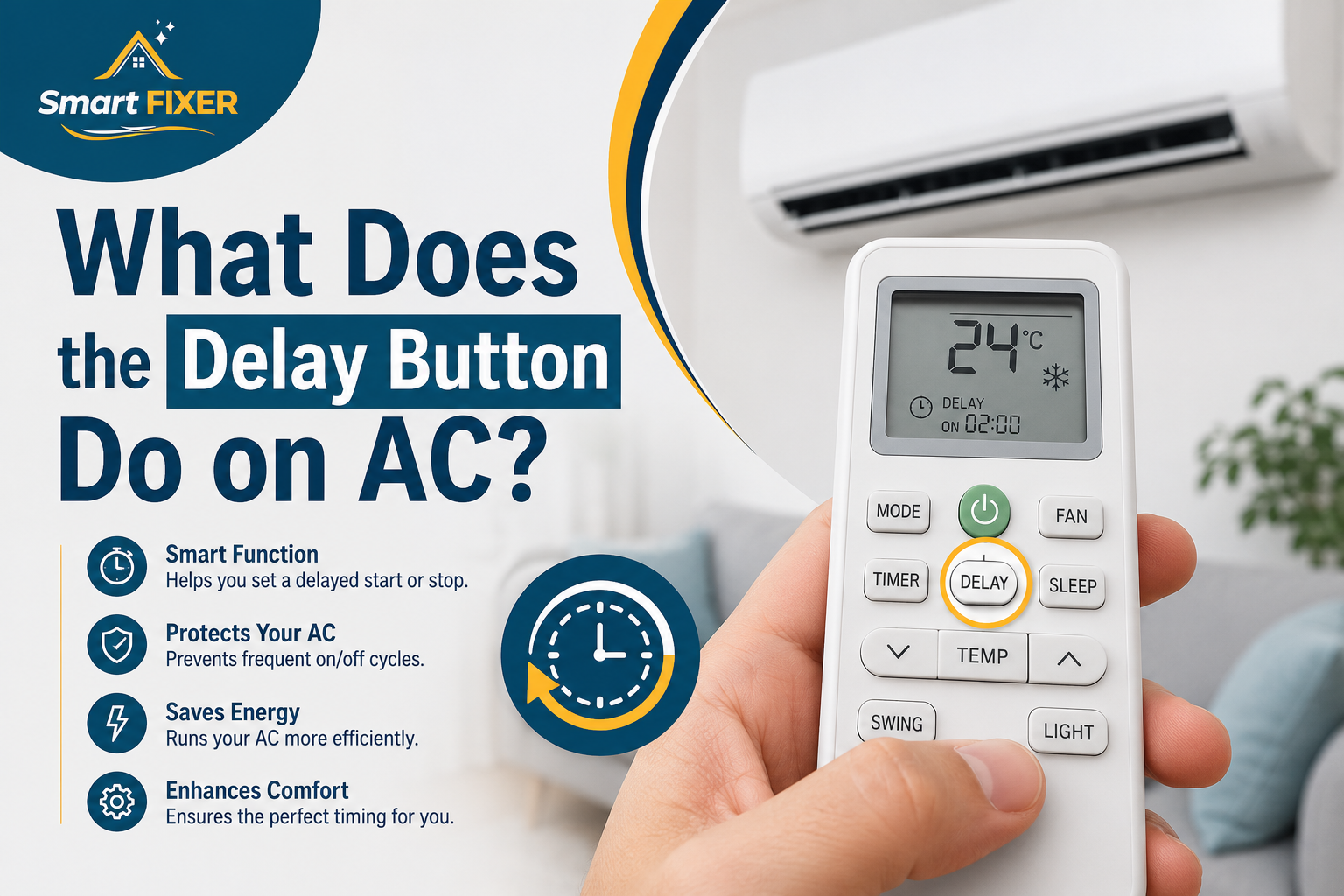
Air conditioners come with several useful features that many users rarely notice. One of them is the delay button do on AC, which often creates confusion. Some people assume it is a timer, while others think it prevents the AC from turning on immediately after being switched off.
In reality, the delay button serves an important purpose. It protects your air conditioner, improves efficiency, and helps extend the lifespan of the compressor. Understanding this feature can prevent unnecessary service calls and help you use your AC more effectively.
What Does the Delay Button Do on an AC?
The delay button temporarily postpones the operation of your air conditioner after it has been switched on, restarted, or after a power interruption.
Instead of allowing the compressor to start immediately, the system waits for a short period, typically around 3 minutes. During this delay, the indoor unit may appear to be running normally, but the compressor remains off.
This waiting period is designed to protect one of the most expensive components of your AC, the compressor.
Without this safety delay, the compressor could restart while refrigerant pressure is still high, leading to unnecessary stress and possible damage.
Understanding the AC Delay Button Function
The AC delay button function acts as a built-in safety mechanism.
Whenever the air conditioner experiences one of the following situations, the delay activates automatically:
- After turning the AC off and back on quickly
- Following a power outage
- After changing cooling modes
- During automatic restart after electricity returns
- After compressor protection detects abnormal conditions
The delay allows internal pressure inside the refrigeration system to balance before the compressor starts again.
This small pause greatly reduces wear and tear.
Why Modern Air Conditioners Use a Delay Feature?
Modern air conditioners are equipped with electronic control boards that constantly monitor compressor operation.
The delay feature offers several important benefits.
Protects the Compressor
The compressor is the heart of every air conditioner.
Restarting it immediately after shutdown can cause:
- High starting current
- Increased mechanical stress
- Compressor overheating
- Reduced compressor life
The delay prevents these issues.
Improves Cooling Efficiency
Starting the compressor only after refrigerant pressure stabilizes helps the cooling cycle operate more efficiently.
This results in smoother cooling performance.
Reduces Repair Costs
Frequent hard starts are one of the common reasons compressors fail prematurely.
Using the delay feature helps avoid expensive repairs.
Extends Equipment Lifespan
Less stress on electrical and mechanical components means your AC lasts longer.
How the AC Delay Timer Actually Works?
The AC delay timer is different from the sleep timer or scheduling timer.
It is an automatic internal protection timer.
The process usually works like this:
| Step | What Happens |
|---|---|
| AC is turned off | Compressor stops immediately |
| User turns AC back on | Indoor display powers up |
| Delay activates | Compressor waits around 3 minutes |
| Refrigerant pressure stabilizes | Internal system balances pressure |
| Compressor starts | Cooling begins normally |
Most users mistake this waiting period as a malfunction.
In reality, it indicates that the protection system is working correctly.
AC Timer Function vs Delay Button Function
Many people confuse the AC timer function with the delay feature.
Although both involve timing, they perform completely different tasks.
| Feature | Delay Button Function | AC Timer Function |
| Purpose | Protects compressor | Schedules operation |
| User Control | Usually automatic | User programmable |
| Typical Duration | Around 3 minutes | Minutes or hours |
| Turns AC On/Off | No | Yes |
| Protects Compressor | Yes | No |
The AC timer function allows users to schedule when the AC should start or stop.
The delay button, however, is designed solely for equipment protection.
What Is the 3 Minute Rule for AC?
One of the most common questions homeowners ask is about the 3 Minute Rule for AC.
This rule simply means:
Never restart an air conditioner immediately after turning it off.
Instead, wait approximately three minutes before switching it back on.
Most modern air conditioners enforce this rule automatically through the built-in delay feature.
Older models may require users to wait manually.
Why Three Minutes?
During operation, refrigerant circulates under high pressure.
When the compressor stops, pressure needs time to equalize.
Restarting too early forces the compressor to work against high pressure, increasing electrical load and mechanical strain.
That is why manufacturers recommend waiting three minutes.
Signs the Delay Function Is Working Normally
You may notice these situations:
- Indoor fan runs but no cooling initially
- Display is active but compressor stays off
- Outdoor unit starts after a few minutes
- Cooling begins automatically after waiting
These are all normal behaviors.
There is usually no need for concern.
When the Delay May Indicate a Problem?
Although the delay feature is normal, there are times when it may signal another issue.
Contact a professional if:
- Delay lasts longer than 10–15 minutes
- Outdoor unit never starts
- Compressor repeatedly stops and restarts
- Error codes appear on the display
- Circuit breaker keeps tripping
These symptoms could indicate problems with the control board, capacitor, compressor, thermostat, or power supply.
Professional diagnosis is recommended.
Common Myths About the Delay Button
Myth 1: The AC Is Broken
Many users assume the AC has stopped working.
In reality, the delay is simply protecting the compressor.
Myth 2: The Delay Wastes Electricity
Actually, the delay helps reduce unnecessary electrical stress and can improve efficiency.
Myth 3: You Can Disable It
On most modern air conditioners, the delay protection is built into the control board and cannot be disabled.
This is intentional because it protects the system.
Myth 4: Delay Means Low Refrigerant
Low refrigerant does not trigger the standard delay feature.
The delay activates regardless of refrigerant level.
Tips to Use Your Air Conditioner Properly
Following good operating practices can improve both efficiency and equipment life.
Avoid Frequent Restarting
Do not repeatedly switch the AC on and off.
Allow the compressor to complete its operating cycle.
Keep Filters Clean
Dirty filters reduce airflow and make the compressor work harder.
Clean filters every few weeks during heavy use.
Set a Comfortable Temperature
Instead of setting the AC to the lowest possible temperature, maintain a comfortable range between 24°C and 26°C.
This improves energy efficiency.
Schedule Regular Maintenance
Professional servicing helps detect issues before they become expensive repairs.
Companies like Smart Fixer recommend routine inspections to keep your cooling system operating efficiently throughout the year.
Does Every Air Conditioner Have a Delay Button?
Not necessarily.
The feature depends on the manufacturer and model.
Generally:
| AC Type | Delay Protection |
| Split AC | Yes |
| Inverter AC | Yes |
| Window AC | Usually Yes |
| Portable AC | Often Yes |
| Older AC Models | May Not Have It |
Most modern inverter air conditioners include automatic compressor protection by default.
Can You Turn Off the Delay Feature?
In almost all residential air conditioners, the answer is no.
The delay is programmed into the electronic control system.
Manufacturers include it to prevent compressor damage and maintain warranty protection.
Attempting to bypass this feature is not recommended.
When Should You Call an AC Expert?
If your AC remains in delay mode for an unusually long time or repeatedly fails to cool, professional inspection is the safest option.
An experienced technician can identify whether the issue involves:
- Compressor faults
- Electrical problems
- Faulty control boards
- Capacitor failure
- Sensor issues
- Refrigerant-related faults
Experienced service providers like Smart Fixer can accurately diagnose these problems and restore your AC’s performance before minor issues become major repairs.
Final Thoughts
Understanding what the delay button do on AC helps eliminate unnecessary worry when your air conditioner doesn’t begin cooling immediately.
The AC delay button function is an intelligent safety feature that protects the compressor by delaying restart for a few minutes after shutdown or a power interruption. It is completely different from the AC timer function, which schedules when your air conditioner turns on or off.
Following the 3 Minute Rule for AC, avoiding frequent restarts, and scheduling regular maintenance can significantly extend your system’s lifespan while improving cooling efficiency.
If your air conditioner remains in delay mode for too long or shows unusual behavior, don’t ignore the warning signs. Contact Smart Fixer for professional inspection, accurate diagnosis, and reliable AC repair services to keep your cooling system running at its best.
Frequently Asked Questions
1. Is the delay button the same as the AC timer?
No. The delay button protects the compressor by postponing startup, while the AC timer function allows you to schedule when the unit turns on or off.
2. Why does my AC wait before cooling?
Your air conditioner is likely following the built-in compressor protection cycle. The delay usually lasts around three minutes and is completely normal.
3. Can I bypass the AC delay function?
Most modern air conditioners do not allow users to disable or bypass the delay feature because it is designed to protect the compressor.
4. Does the delay button save electricity?
Its primary purpose is compressor protection rather than energy savings. However, by reducing compressor stress and preventing hard starts, it can contribute to better long-term efficiency.
5. What should I do if the delay lasts more than 15 minutes?
If the compressor does not start after an extended delay, there may be an electrical or mechanical problem. It’s best to have the system inspected by a qualified AC technician.